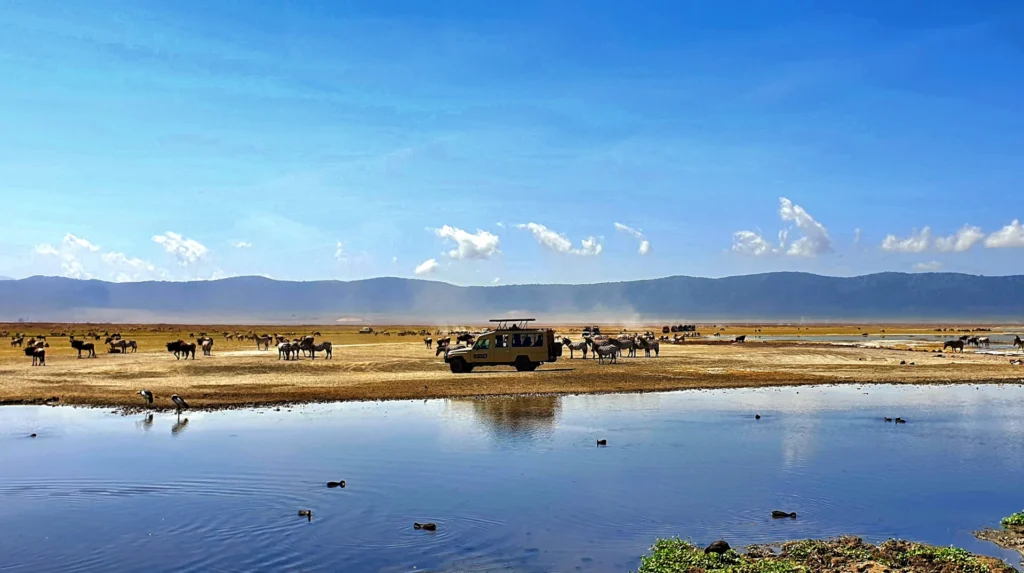
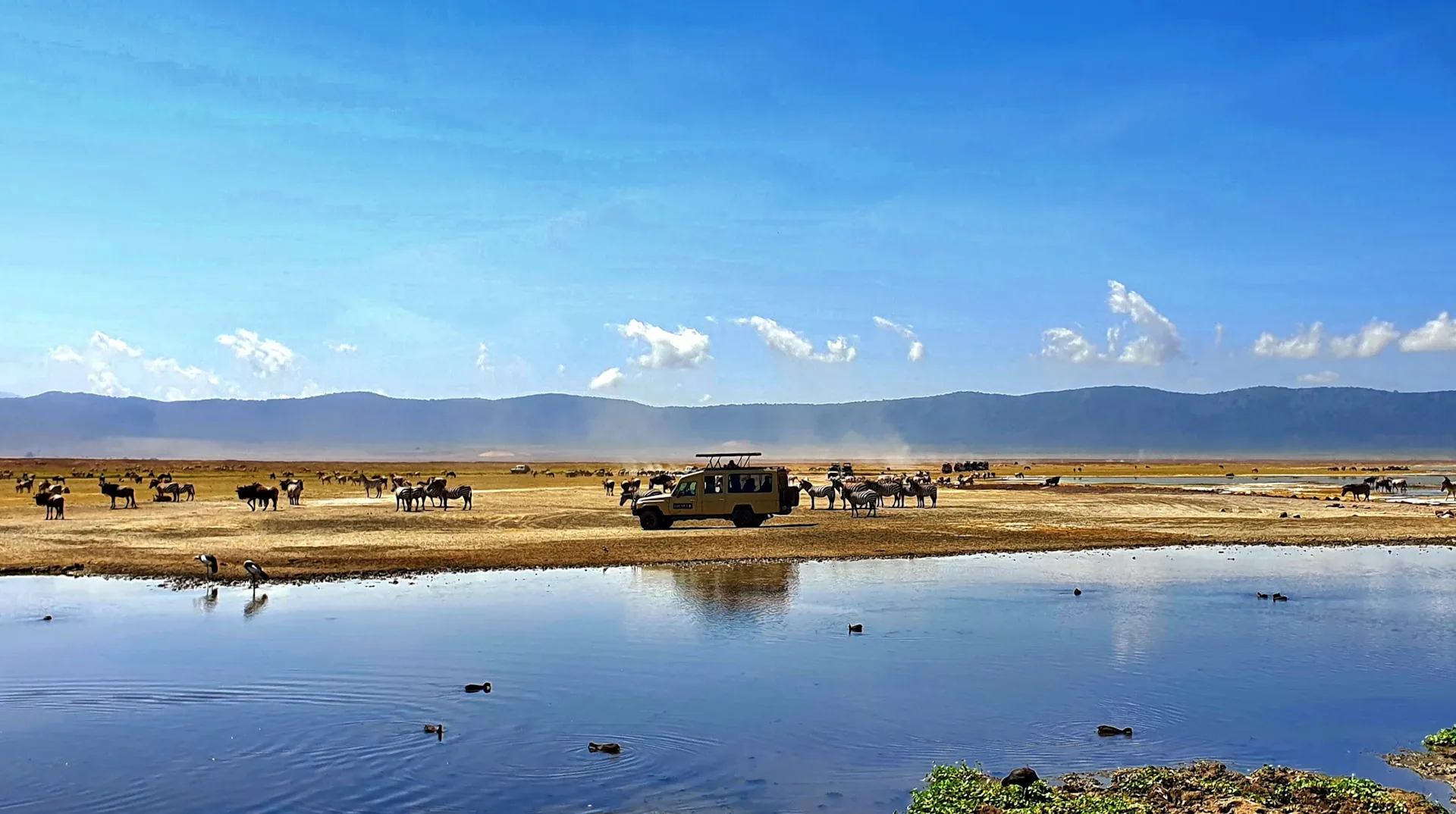
The Ngorongoro Crater is the world's largest intact volcanic caldera, a vast bowl about 20 kilometres wide and 600 metres deep that holds one of the densest concentrations of wildlife in Africa. Within its walls live around 25,000 large animals, including the Big Five, and the setting is so dramatic that many visitors say it is the most beautiful place they have ever been on safari.
The crater is the best place in Tanzania to see black rhino, and it is excellent for lion, spotted hyena, elephant, buffalo and hippo. Flamingos gather on Lake Magadi, and the Lerai forest shelters leopards and bushbucks. The wider conservation area includes the highland forests of Empakaai Crater, Olduvai Gorge, and the volcano of Ol Doinyo Lengai, with Maasai communities living and grazing alongside the wildlife.
A crater descent is normally a half-day or full-day drive, and we place it at the end of a Serengeti safari or on its own after Tarangire and Lake Manyara.
Pros and cons
Pro: A natural amphitheatre with wildlife packed into it
Pro: Black rhino, lion and large herds on one floor
Pro: An easy day from Arusha
Pro: Lodges on the rim with views over the crater
Pro: Olduvai Gorge and Maasai communities nearby
Con: Busy on the crater floor in peak months
Con: Cold and often misty on the rim
Con: Time on the floor is limited by the park rules
Wildlife
The crater floor is a self-contained world with resident lion, spotted hyena, elephant (mostly big bulls), buffalo, hippo, wildebeest, zebra, eland and Thomson’s gazelle, and a small population of black rhino. The crater has no giraffe or impala. Cheetah and serval are sometimes seen, and leopards live in the Lerai forest.
Chance of seeing
Black rhinosmall populationGood
LionExcellent
Spotted hyenaExcellent
African elephantlarge old bullsGood
BuffaloExcellent
HippoGood
WildebeestExcellent
Plains zebraExcellent
ElandGood
CheetahAverage
LeopardAverage
ServalAverage
Lesser flamingoon Lake MagadiGood
Our estimate for a stay of two or three nights with a good guide. Wildlife is wild, so nothing is promised.
Scenery
The crater walls rise steeply from a flat, open floor with a soda lake, a forest, a swamp and grassland. From the rim you can see right across the caldera, often with cloud rolling over the edge in the early morning.
Activities
Crater floor safari: a half- or full-day drive for rhino, lion and hippo
Lake Magadi: a stop to see flamingos and hippos
Olduvai Gorge: a visit to the museum and one of the world’s great fossil sites
Empakaai Crater walk: a hike to a lake-filled caldera with a ranger
Maasai village visit: a cultural stop with a local guide
Activities here
Cultural & Community Visits
Game Drives
Hiking & Walking
Weather and climate
The crater rim at 2,200 metres is cool and often cloudy, with temperatures of 8°C to 20°C, while the crater floor is warmer by day. Rain falls from November to May, heaviest in March to May.
Month by monthDay °CNight °CRain (mm)
20°8°100Jan
20°8°120Feb
20°9°190Mar
19°10°280Apr
18°9°170May
17°7°30Jun
16°6°20Jul
17°6°20Aug
18°7°20Sep
19°8°40Oct
19°9°120Nov
19°8°130Dec
Average climate in Ngorongoro Conservation Area
Month
Day °C
Night °C
Rain mm
Jan
20
8
100
Feb
20
8
120
Mar
20
9
190
Apr
19
10
280
May
18
9
170
Jun
17
7
30
Jul
16
6
20
Aug
17
6
20
Sep
18
7
20
Oct
19
8
40
Nov
19
9
120
Dec
19
8
130
Approximate long-term averages. Higher ground is cooler, and forests can rain in any month.
Dry season
June to October is dry, with clearer skies and excellent game viewing on the crater floor. Mornings on the rim can be cold, so bring a warm jacket.
Wet season
The rains bring mist and fresh green grass, and some of the roads down to the crater can be slippery. The crater is quiet in these months, and the animals are still easy to find because the floor is open.
Best time to visit
The crater is rewarding all year because the animals live there permanently. June to October is the driest and most comfortable, and the green season from November to May is quieter with lower rates.
Best time to visit Jun to Oct
JanJanuary: Good
FebFebruary: Good
MarMarch: Fair
AprApril: Heavy rains
MayMay: Fair
JunJune: Excellent
JulJuly: Excellent
AugAugust: Excellent
SepSeptember: Excellent
OctOctober: Excellent
NovNovember: Good
DecDecember: Good
Excellent
Good
Fair
Heavy rains
How to get there
The crater is about 180 kilometres from Arusha, a drive of around three and a half to four hours via Karatu, and many guests stay on the rim. It lies on the road between Lake Manyara and the Serengeti, and light aircraft use the Lake Manyara airstrip.
Permits and fees
Conservation area fees and the crater vehicle fee are included in our safaris. Most visitors need a Tanzania visa, applied for online before travel or bought on arrival, and a passport valid for at least six months.
Health and safety
The crater rim is high and cold, so pack warm clothes. The crater floor is dry and dusty. Please take advice on malaria before you travel; the risk is low at altitude but the crater floor is lower.
Stay on the rim if you can, so you reach the crater floor early, before the other vehicles, when the animals are at their most active.
Uwera Travels specialists
Safaris from
US$1,786 per person
Plan your time in Ngorongoro Conservation Area
Every safari we run is private and built around you. Tell us your dates and what you hope to see, and we will shape the route, the lodges and the permits.
Essential cookies keep this site working. With your permission we also remember the safaris and places you have viewed. You can change your mind any time from Cookie settings in the footer.


 National ParkSerengeti National ParkThe Great Migration