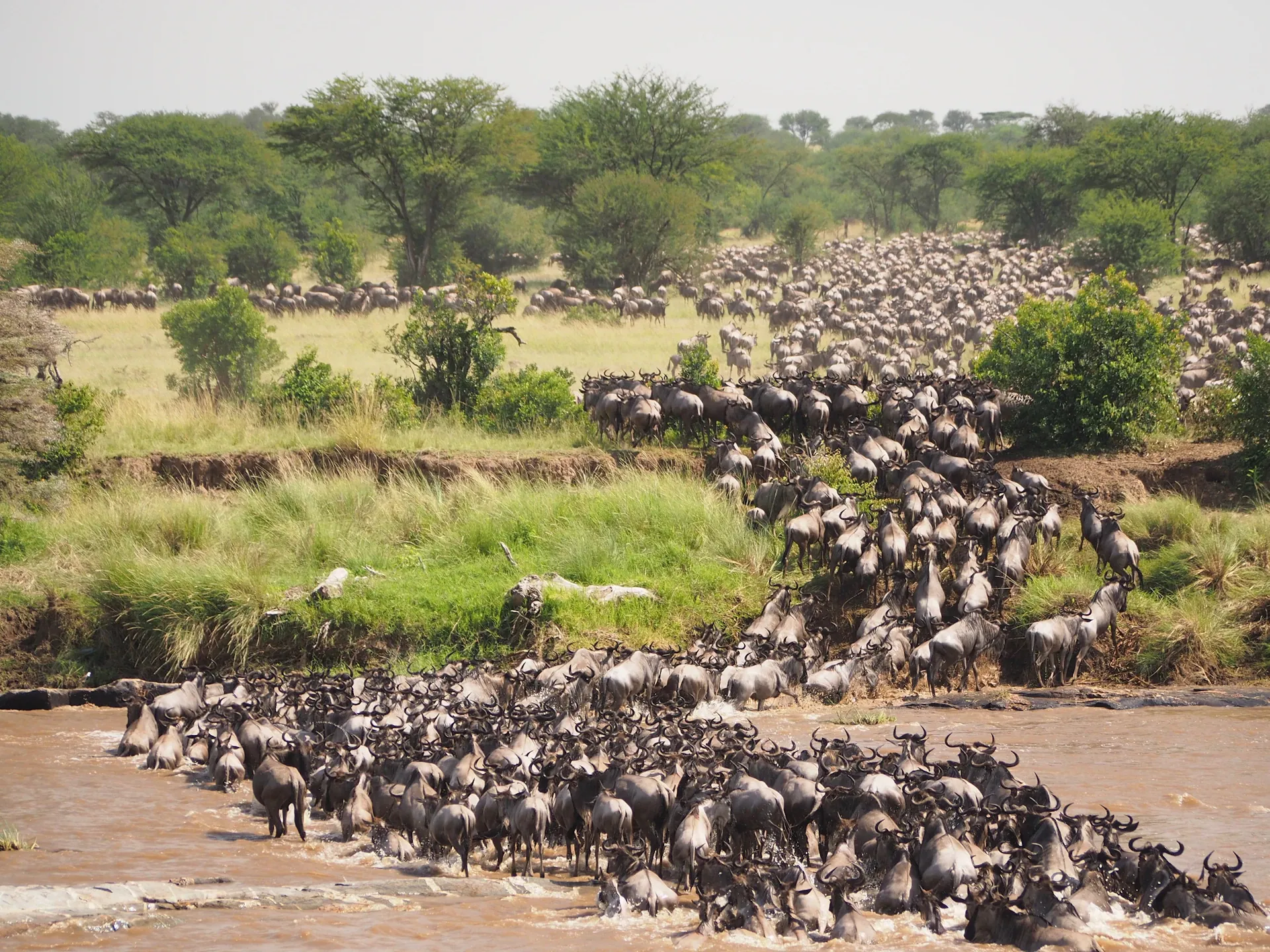

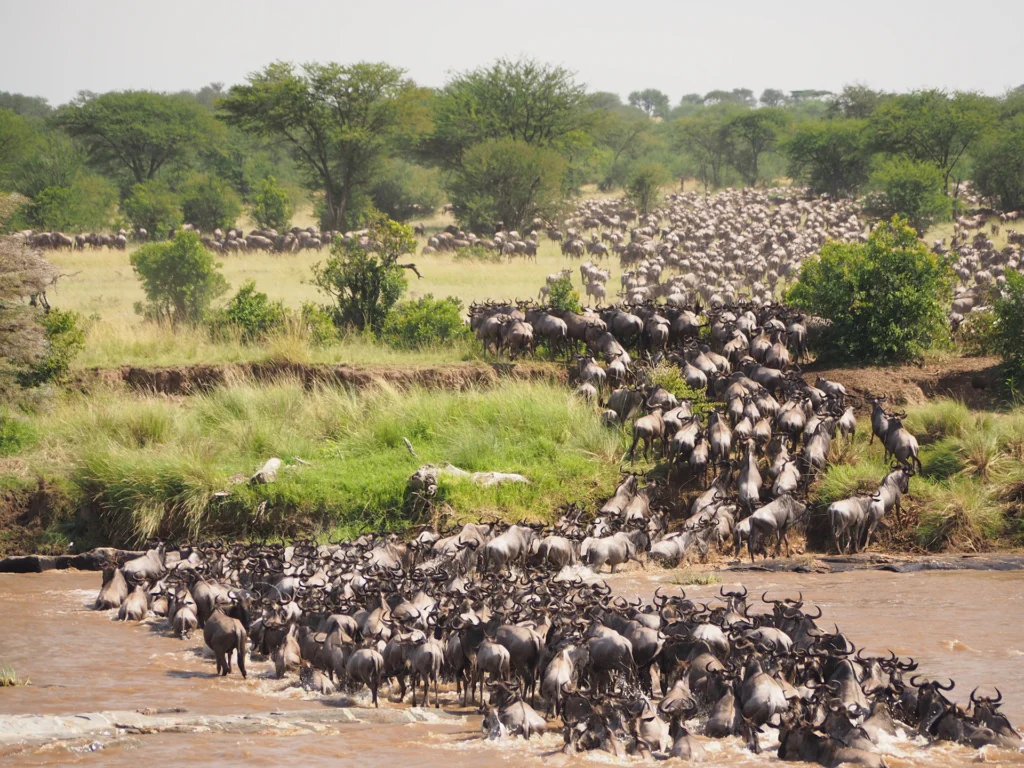
The Serengeti is the great wildlife stage of Africa: 14,750 square kilometres of golden plains, granite kopjes, riverine woodland and open sky, home to the largest overland migration on Earth. More than a million wildebeest, with hundreds of thousands of zebra and gazelle, follow the rains in a circular journey through the park, and the herds are always somewhere, even if their position changes with the season.
The Serengeti is also one of the best big-cat parks in Africa. Lions rest on the kopjes, leopards lie in the sausage trees along the Seronera River, and cheetah hunt on the short-grass plains. The migration's calving season in the south from January to March, the Grumeti crossings in the Western Corridor, and the dramatic Mara River crossings in the north are among the planet's great wildlife events.
We plan the Serengeti with care, placing you in the part of the park where the herds are most likely to be, often by combining a fly-in camp with a mobile camp that follows the animals.
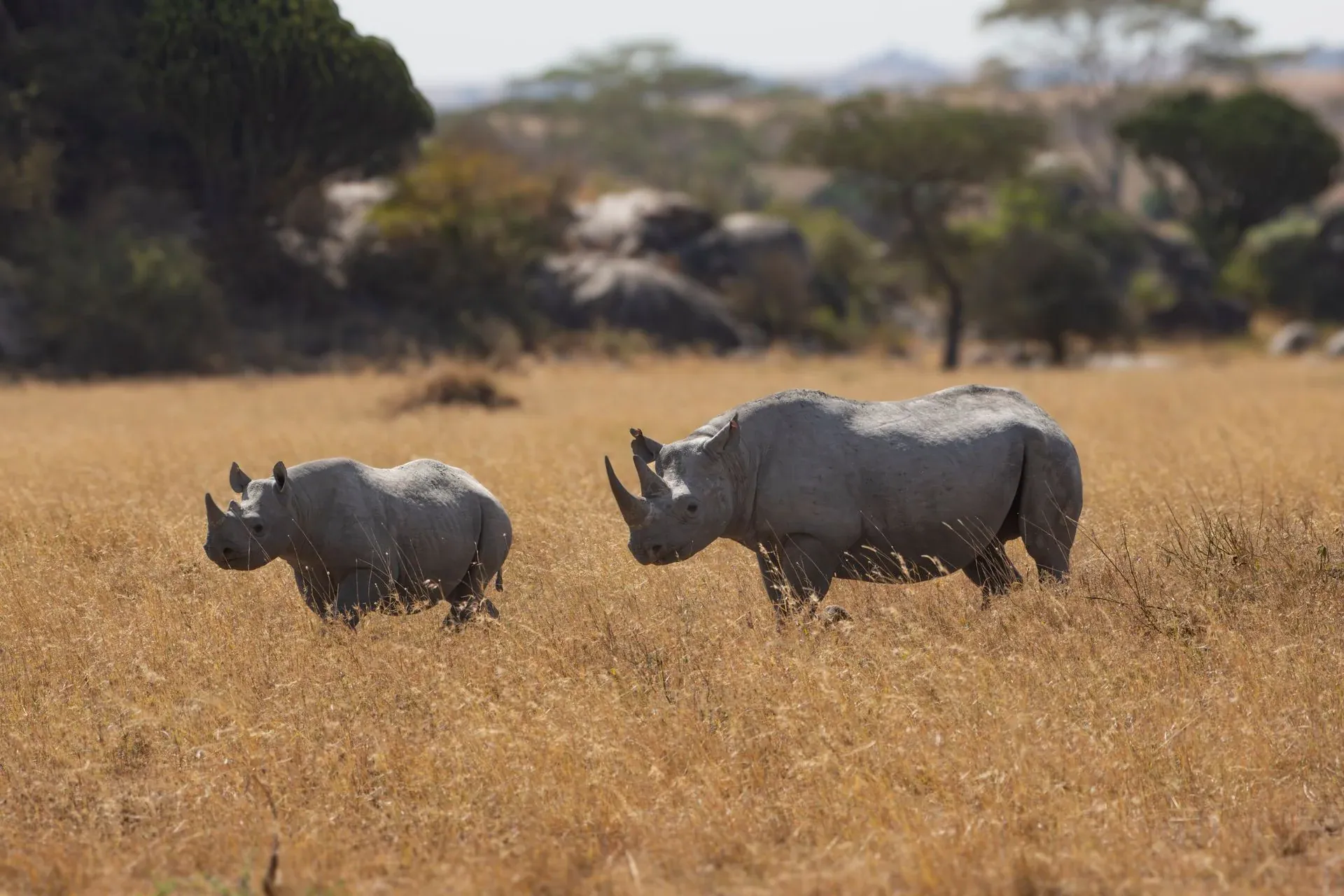
The Serengeti has the Big Five in good numbers, with lion, leopard, elephant and buffalo seen regularly and a few black rhino in the Moru Kopjes. Cheetah are frequently seen on the southern plains, spotted hyena are numerous, and wild dog are occasionally recorded. The plains game is huge: wildebeest, zebra, Thomson’s and Grant’s gazelle, topi, eland, giraffe, hartebeest and warthog. The Grumeti and Mara rivers hold some of the largest crocodiles in Africa.
Chance of seeing
Our estimate for a stay of two or three nights with a good guide. Wildlife is wild, so nothing is promised.
The southern plains are endless short-grass savannah under towering clouds. Further north the land rolls into acacia woodland, granite kopjes and rivers lined with fig and sausage trees. In the west the Grumeti River flows through riverine forest, and in the north the Mara River cuts through wide open grassland.
Activities here
The Serengeti has warm days of about 25°C to 28°C and cooler nights, with temperatures dropping to around 14°C in the dry season. The long rains fall from March to May and the short rains in November and December.
| Month | Day °C | Night °C | Rain mm |
|---|---|---|---|
| Jan | 27 | 16 | 80 |
| Feb | 27 | 16 | 100 |
| Mar | 26 | 17 | 130 |
| Apr | 25 | 17 | 200 |
| May | 25 | 16 | 130 |
| Jun | 25 | 14 | 25 |
| Jul | 25 | 14 | 10 |
| Aug | 26 | 14 | 20 |
| Sep | 27 | 15 | 25 |
| Oct | 27 | 16 | 50 |
| Nov | 26 | 17 | 100 |
| Dec | 26 | 16 | 110 |
Approximate long-term averages. Higher ground is cooler, and forests can rain in any month.
June to October is the dry season, with warm sunny days and cold early mornings. The grass is short, rivers are low, and animals gather near water, which makes game viewing superb. It is also the time of the Mara River crossings in the north.
The rains turn the plains green and the herds move south for calving in January to March. Showers are mostly short afternoon storms, the roads can be soft in April and May, and the park is quiet and photogenic.
Where the herds are depends on the month. January to March is calving season in the southern plains and the Ndutu area. April to June is the long rains, when the herds move through the central and western Serengeti. June and July are the Grumeti River crossings in the Western Corridor, and July to October is the Mara River crossings in the north. Late October to December sees the herds return south, and the Serengeti is fascinating whenever you come, since the big cats are always there.
Best time to visit Jan to Feb, Jun to Oct
Most guests fly from Arusha to one of the Serengeti’s airstrips, which takes about an hour and a half to Seronera, or the northern strips near Kogatende. The drive from Arusha takes eight to nine hours, usually split with a night at Karatu or Ngorongoro, and can be combined with a flight out of the park. The Serengeti also links with the Masai Mara by light aircraft.
Park fees are included in our safaris. Most visitors need a Tanzania visa, which can be applied for online before travel or bought on arrival at the main airports, currently US$50 for a single-entry tourist visa. Your passport must be valid for at least six months. Hot-air balloon flights are arranged as extras.
The Serengeti is a malaria area, so please take medical advice before you travel. The roads are dusty and bumpy, so bring a scarf and sun protection. Medical evacuation is by air, so good travel insurance is essential.
 Wildlife Reserve & SanctuaryNgorongoro Conservation AreaA day on the crater floor16 safaris
Our take
“Our take”
Give the Serengeti at least three nights, and tell us your travel month, because we choose the camp around where the herds are.
Safaris from
US$4,672 per person
Plan your time in Serengeti
Every safari we run is private and built around you. Tell us your dates and what you hope to see, and we will shape the route, the lodges and the permits.
Made to measure
Tell us how you like to travel and we will build a private journey around it: the right lodges, the right pace and the permits already in hand.
Start planningCookies
Essential cookies keep this site working. With your permission we also remember the safaris and places you have viewed. You can change your mind any time from Cookie settings in the footer.